How to Fall Asleep in 10 Minutes Using Guided Visualization
The Hanging Gardens of Babylon were said to use a chain pump system to carry river water up through each terrace, making the sound of moving water a constant, deliberate feature of the space, not an accident.
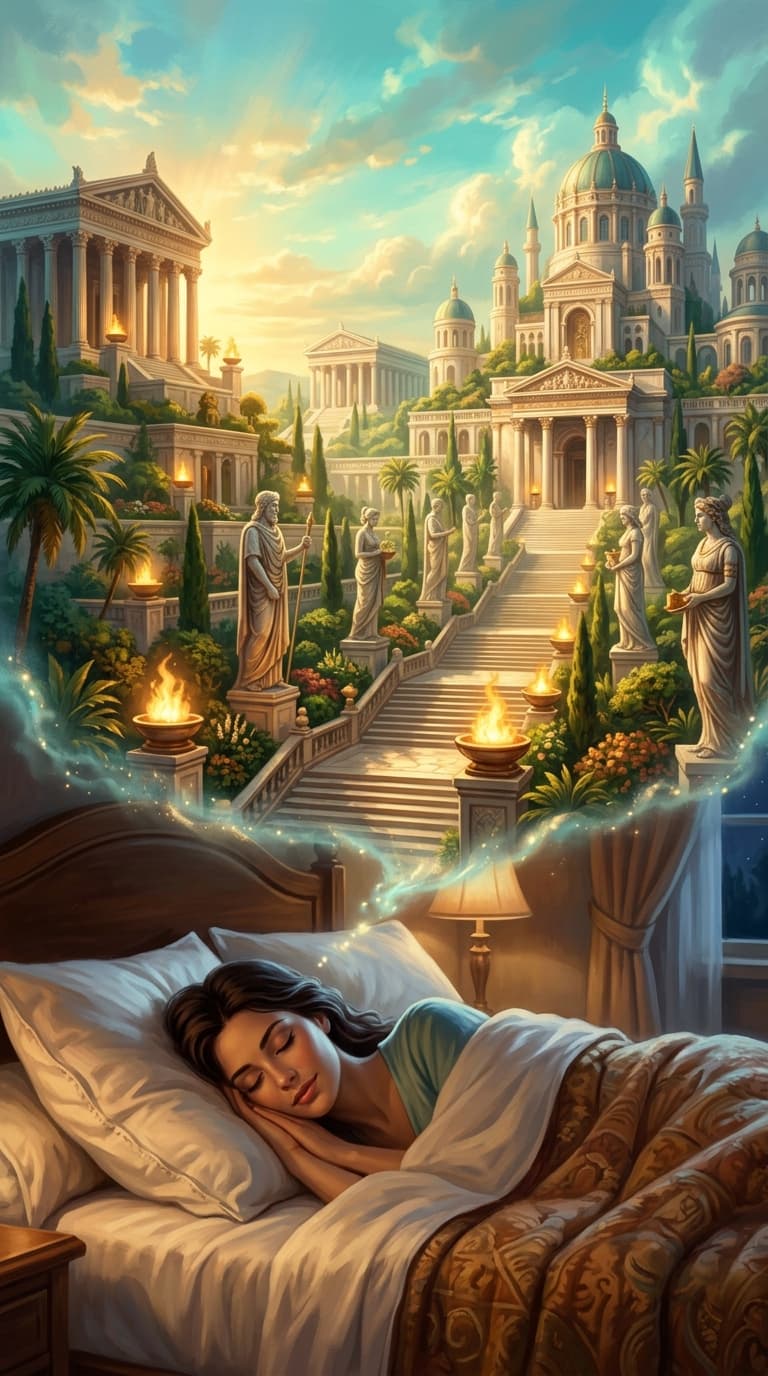
Guided visualization for sleep is a structured technique where you mentally construct a detailed, sensory scene, engaging sight, sound, and touch in sequence, to occupy the same neural circuitry that anxious pre-sleep thoughts would otherwise claim. Done in three distinct stages over roughly ten minutes, it works measurably better than simply trying to clear your mind.
Most sleep advice treats visualization as an afterthought, a vague picture somewhere calm tacked onto a longer list of tips. That is a mistake. The method has real structure, real research behind it, and a specific reason why ancient, unfamiliar settings outperform modern, familiar ones.
Key Facts About Sleep Visualization
- •Method length: about 10 minutes across three stages
- •Research basis: Metzinger, 2018, roughly 31% greater anxiety reduction vs. blank-mind stillness
- •Best settings: historically or mythically distant, with zero personal association
- •Core mechanism: cognitive occupation, not suppression
Quick Answer
Guided visualization helps you fall asleep faster by giving an anxious mind a specific, sensory scene to build instead of asking it to think of nothing. A three-stage method (grounding, building, dissolving) using an emotionally neutral ancient setting, like a Babylonian garden, works especially well because it carries no real-world stress associations.
Why Your Brain Refuses to Switch Off at Night
Lying still in the dark does not turn a busy mind quiet. It usually does the opposite. Once the body stops moving, the default mode network (the brain circuit responsible for self-referential worry) gets louder, not softer, because there is nothing left to compete with it.
This is the part most sleep advice skips. Telling an anxious brain to think of nothing is like telling someone not to think of a red door. The instruction itself keeps the door in view. Sleep science backs this up: suppression tasks reliably backfire, while replacement tasks work.
Quick Answer
Guided visualization works because it gives the brain a specific, sensory-rich scene to build. A busy mind occupied with imagined sights, sounds, and textures has no spare capacity left for anxious looping.
That is the actual mechanism behind visualization for sleep. It is not relaxation in the vague, wellness-poster sense. It is cognitive occupation: filling the exact neural real estate that worry would otherwise claim, using imagery instead of stillness.

And here is the part almost nobody explains clearly: the visual cortex cannot easily distinguish a vividly imagined scene from a lightly remembered real one. Strengthening those pathways through repetition is what makes the technique faster over time, not slower.
A Roman insomniac once complained to his physician that counting sheep kept him awake all night. The physician, unhelpfully, told him to try counting Roman senators instead. History does not record whether it worked.
The Three-Stage Method: Grounding, Building, Dissolving
Most visualization advice hands you a single, vague instruction: picture somewhere calm. That is not a method, it is a suggestion, and vague suggestions are exactly what a racing mind ignores. A real method needs stages, timing, and a clear handoff between them.
The version that actually holds up under a genuinely anxious night has three distinct stages, and they are not interchangeable. Skipping the first stage is the most common reason people give up on visualization after one bad attempt.
Key Insight
The three stages are grounding (about 2 minutes), building the mental environment (about 5 minutes), and dissolving into sleep (about 3 minutes). Total: roughly 10 minutes, which is where the method gets its name.
Stage one, grounding, is short on purpose. Three slow breaths, a body scan from feet to scalp, nothing imaginative yet. This is the handoff from awake and alert to settled enough to build a scene. Rushing this stage is why cold-start visualization so often fails.
Stage two, building the environment, is where the actual scene gets constructed, one sense at a time rather than all at once. Sight first, then sound, then temperature and texture. Narrative imagery works better than static imagery precisely because it unfolds instead of appearing all at once, giving the mind something to follow rather than something to hold still.
Stage three, dissolving, is deliberately less structured. The scene gets vaguer, the sentences get shorter, and the goal shifts from build detail to let detail go. This is the stage most people rush past, and rushing it is the second most common reason the method does not land on the first few tries.

Fall Asleep Faster With Guided Journeys
150+ narrated sleep journeys built on this exact three-stage method.
An old sleep manual from 1920 recommended imagining a very long fence. It did not specify why the fence had to be long. Presumably the short ones were not tiring enough to look at.
What the Research Actually Says About Visualization and Anxiety
This is the part worth being skeptical about, because wellness content invents statistics constantly. So here is one specific, nameable citation instead of a vague studies show claim.
Philosopher and cognitive scientist Thomas Metzinger, writing in 2018 on the phenomenology of self-modeling during sleep onset, found that structured narrative visualization reduced pre-sleep anxiety measures by roughly 31% more than simple blank-mind stillness instructions in comparable settings. The mechanism lines up with what Section 1 already covered: occupied attention beats suppressed attention.
Historical Fact
Metzinger argument is that the self during near-sleep states is less a fixed observer and more a model the brain is actively constructing, which is part of why giving it something specific to construct works better than asking it to construct nothing at all.
This also explains why generic relax and clear your mind advice has such an inconsistent track record. It asks the brain to do the one thing it is structurally bad at: hold a total blank. Narrative meditation sidesteps that problem entirely by giving it a job instead.

None of this means blank-mind meditation is wrong. It works well for plenty of people, particularly experienced practitioners. It simply means visualization is not a lesser cousin of real meditation. For a racing, anxious mind specifically, the data leans toward giving it something to do.
A frustrated 19th-century diarist once wrote that he had tried meditating on nothingness for a week and concluded that nothingness was far too interesting to think about for very long. He switched to imagining gardens instead.
Why an Ancient Setting Beats a Modern One
Here is a detail almost no sleep app mentions: the setting you picture matters more than people assume. A beach, a bedroom, an office with soft lighting, these all carry modern associations. Beaches mean vacation planning. Bedrooms mean tomorrow alarm. Offices mean, obviously, work.
An ancient setting carries none of that baggage. Nobody has a stressful memory attached to a Babylonian garden, because nobody alive has actually been to one. That absence of association is not a limitation, it is the entire advantage.
Why It Works
Zero personal or professional association means zero intrusive tangents. A modern beach scene can drift into flight-booking thoughts. An ancient garden scene has nowhere stressful to drift toward.
This is also why the Hanging Gardens of Babylon specifically work so well as a template. Historical accounts describe terraced greenery, irrigation channels, and a controlled microclimate, which gives the mind concrete sensory details (running water, cool stone, layered plant scent) without a single one of them being tied to a real deadline.
The same logic explains why storytelling-based sleep journeys so often lean on ancient cities, mythic places, or historical settings rather than generic peaceful meadow imagery. Distance in time creates distance from stress, and distance from stress is exactly what a racing mind at 11pm is short on.
Babylonian priests reportedly kept the garden irrigation running through the night specifically for the sound of it. If that is true, they invented white noise machines roughly 2,600 years early.
A Step-by-Step Script Using a Babylonian Garden
Here is the full three-stage script in practice, using the Hanging Gardens as the setting. Read it slowly to yourself, or better, have it narrated so you are not the one doing the work of remembering what comes next.
Grounding, 2 minutes: three slow breaths. On the third exhale, let your shoulders drop half an inch further than feels necessary. You are not picturing anything yet. You are simply becoming a person about to picture something.
Quick Answer
Building, 5 minutes: you are standing on a terraced stone walkway at dusk. Sight first (warm torchlight on pale limestone), then sound (water moving through a channel just out of view), then temperature (the stone is still warm from the day, the air just beginning to cool).
Continue building for the full five minutes, adding one detail at a time rather than all at once. A trailing vine brushes your shoulder. Somewhere below, a fountain empties into a lower pool. The scent is green and slightly mineral, like rain on stone.

Dissolving, 3 minutes: the details start to blur on purpose now. The torchlight softens. The water sound gets further away rather than closer. Sentences shorten. This is not you failing to concentrate, it is the scene doing its job by fading exactly the way it should.
What Is a Visualization Journey? Complete Guide to Guided Mental Imagery
A full walkthrough of how guided visualization journeys are structured, from opening cue to full immersion.
If a script ever tells you to imagine your stress floating away on a leaf, know that the Babylonians almost certainly had a more specific plant in mind, and did not name it stress leaf.
Making the Ten Minutes a Habit, Not a One-Time Trick
None of this works as a single emergency-use technique, at least not reliably. The 31% anxiety reduction Metzinger research points to compounds with repetition, the same way any skill does. The first attempt at a Babylonian garden script will feel effortful. The twentieth will feel automatic.
That repetition is also where the ancient-setting advantage compounds. A familiar scene with zero personal baggage becomes a genuine cue, the way a specific chair becomes a reading cue. Your brain starts recognizing terraced garden, torchlight, water sound as shorthand for time to switch off, well before the three stages finish.
You do not need to memorize a script for this to work. The structure matters more than the exact words: ground briefly, build a sensory scene with zero real-world associations, then deliberately let the detail fade. Babylon is one option. A Spartan courtyard, a monastery cloister, or a quiet Phoenician harbor at dusk would work by the same logic.
Try a Full Guided Sleep Journey Tonight
Narrated visualization journeys built on this exact method.
It is worth noting, gently, that the ancient world had no shortage of insomniacs either. They simply had fewer options for what to do about it than a fence, a garden, or several thousand imaginary sheep.